How to Upload Tunes From Older Version Forza
Bated from driving skill, tuning is one of the cornerstones of being a corking driver. A car that you have upgraded may have the most power, but a shoddy tune will leave it in the dust with more balanced and focused cars.
Forza Horizon 5 caters to a lot of demographics when it comes to its racing. In one race y'all could be racing on the highway with your human foot to the pedal without much care for handling, while in other races, you will be navigating a twisty rail in the dirt that requires a lot more handling and grip than just raw ability.
The way you'd melody your machine for one type of race is completely different to how you should tune it for some other.
In this Forza Horizon five tuning guide, nosotros'll exist going through the best tuning setups in Forza Horizon five across several racing disciplines that the game has to offer, and come with the best tunes for each discipline and automobile class and then y'all can smoke the competition.
Whether you're looking for road, dirt rally, cross country, drag, or migrate tuning, in this FH5 tuning guide, you'll find everything you need to know.
How to Unlock Tuning
In order to kickoff tuning your car, yous will have to make certain that the appropriate upgrades are installed on your motorcar. Several tuning options are only opened when you install a specific upgrade to your motorcar.
You can find the upgrade menu in the Garage menu under the Upgrades & Tuning menu. From there, select the Custom Upgrade option and start installing those upgrades.
Below will be a listing of performance upgrades that will unlock their specific tuning options. They are arranged past which upgrade menu you can discover them in.
1. Platform and Treatment
- Race Brakes – All Brake tuning options
- Race / Drift / Rally Spring and Dampers – All Alignment, Leap, and Damper tuning options
- Race Front Antiroll Bar – Front Antiroll Bar tuning choice
- Race Rear Antiroll Bar – Rear Antiroll Bar tuning pick
2. Drivetrain
- Sport Transmission – Last Drive tuning only
- Any Race Transmission – All Gearing tuning options
- Sport Differential – Acceleration Differential tuning simply
- Race / Rally / Offroad / Drift Differentials – All Differential tuning options
iii. Tires and Rims
- Any Tire Compound – All Tire tuning options
4. Aero and Appearance
- Adjustable Forepart Bumper – Front Aero Downforce tuning option
- Adaptable Rear Wing – Rear Aero Downforce tuning option
Auto Upgrade is also an option available if y'all are looking for a quick way to upgrade your car into some other form but we generally avert doing this as you have no control over what parts become into your car.
Information technology is better if you yourself upgrade your car so you can prioritize and build how you want your car to drive.
How to Tune Your Car
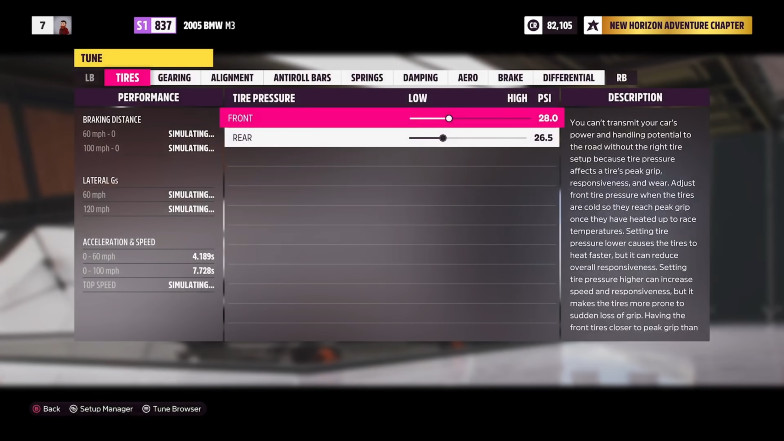
At present that we accept our upgrades, nosotros can now starting time tuning! Tuning your car might sound complex, merely it is much simpler than you lot think it is, especially in a rather arcadey racing game like the Forza Horizon series.
The easiest fashion to get over this hurdle is to familiarize yourself with the tuning options and how they interact with your cars.
Below will be the tuning categories that you lot volition be finding in the tuning menu as well equally the tuning options per category. Nosotros volition be breaking down these options and what they touch on when it comes to driving.
Tires
Although at that place are technically ii options here (front and rear tire pressure), they generally do the same affair.
Adjusting your tire force per unit area affects how your tires react when going at speed too as how much estrus they produce. The softer you prepare your tires, the quicker they generate heat, and in plow, get grip much quicker.
The downside to this is if a tire becomes as well hot, the tire starts to degrade, leading to performance loss.
The same goes for the opposite spectrum. A harder tire allows for more nimble handling but generates less heat, making the tires slide more than.
Mostly though, we go for a softer compound on both rear and front tires equally the majority of the races are not long enough to justify a tire that needs to be heated upwards versus a tire that is always or near elevation temperatures.
Gearing
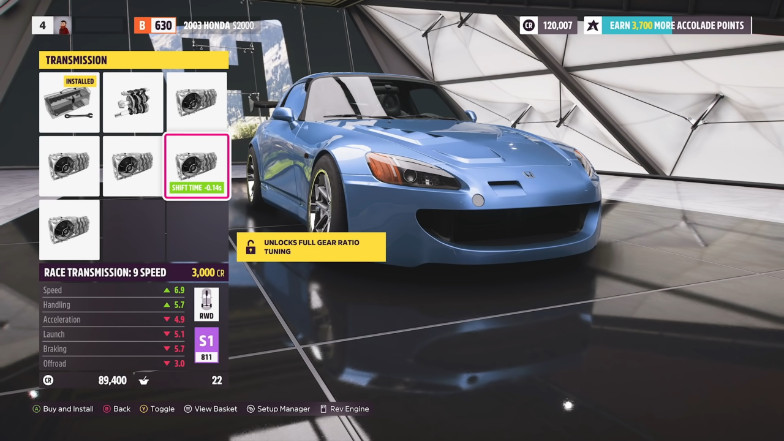
In the gearing bill of fare, you can adjust the gear ratios as well as the last bulldoze setting. Gear ratios pertain to the altitude of ane gear from some other. A tighter gear ratio means that you volition be rowing through the gears much quicker leading to meliorate dispatch, just will besides hinder your top speed.
A longer gear ratio takes advantage of the distance between the gears and yous will exist able to build up more speed, this is at the cost of acceleration though as it takes longer to get into a higher rev.
A general tip when tuning your gearing is to look at the gear ratio chart and adjust the final drive until you can run into all the gear stems in the graph completely. Adjusting the terminal drive basically adjusts all gears in unison, preserving their ratios.
When tuning the individual gear ratios, you can so effort and practise some practice runs while shifting upwards on the redline.
If you shift upwards and hit the rev limiter near immediately or are experiencing too much wheelspin, and then effort to altitude your gear ratios more. Vice-versa if you think you shift into besides low a rev range.
Y'all tin can also tune your start gear into a longer gear if you recall you are producing too much wheelspin when coming from a standstill. The opposite applies if y'all have an affluence of grip and not enough power to launch your motorcar. For that, you must shorten your get-go gear.
Alignment
The alignment category pertains to how your tires and interruption are aligned to the route. We generally want to have a neutral alignment at all times and so that our tires are always hitting the pavement fully.
That said though, tuning everything to 0 is non exactly the way to go every bit a moving car will shift its weight continuously and therefore volition have a dynamic variable to your alignment. Information technology is, therefore, better to tune for these variables.
Camber
When it comes to tuning camber, it is almost always better to become for a by and large negative camber. While this might non be optimum going in a direct line, it is best for taking corners.
Every bit you turn, your car'due south weight shifts, and the amount of tire in contact with the route increases, which is where we want almost of our grip anyhow.
Toe
Toe can actually be left neutral as information technology pertains to how a tire is aligned to the road horizontally. The straighter the toe is, the better. However, in that location are some cases when tuning the toe comes in handy.
Tuning your toe to be toe-in may assistance stubborn cars plow in more past having the wheels signal in, leading to a tighter turning radius at the cost of straight-line stability.
Caster
Adjusting the caster also enhances straight-line stability. The more caster you punch in, the straighter your tires are to the road, likewise much will leave yous with a narrower turning radius though. Adapt appropriately whether yous need more than stability (positive) or more turn-in (negative).
Antiroll Confined
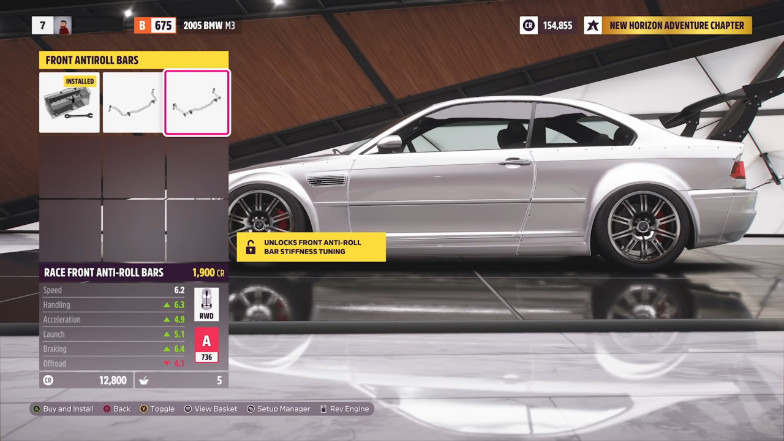
Antiroll confined help with keeping the machine stable during corners; it reduces the car's body roll. Besides soft and the car becomes very unstable through corners, too stiff and the car becomes prone to tripod which is the act of the inner tire in a corner come off contact with the road.
A general rule of thumb with antiroll confined is to first discover the sweet spot with the fronts (ordinarily a quarter of the bar on the soft side) and adjust accordingly with the rear. By adjusting the rear antiroll bars, you tin melody the characteristics of your car.
Making the rears stiffer than the fronts will result in more than oversteer, while softer rears will result in more understeer.
Springs
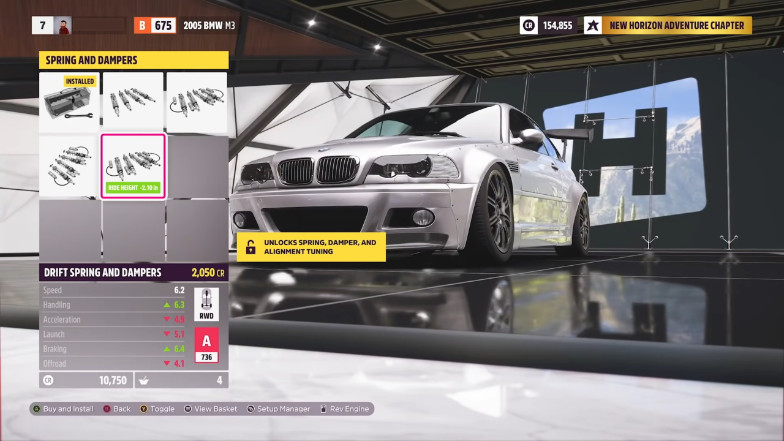
Tuning your springs has well-nigh the same philosophy as the antiroll bars (softer rear springs effect in more understeer, etc.) except that information technology encompasses more factors like squat during acceleration and weight transfer under braking.
It is too important to accept annotation of the engine placement of your car and the weight distribution as you will want stiffer springs where nearly of the weight is to increment the stability of the car.
Springs
Springs that are besides stiff will result in bumps and dips on the road being more than prominent to the handling of a car while springs that are as well soft will result in your car being unstable during acceleration and nether braking.
In general, when it comes to road racing, stiffer springs are more than preferred to requite more than stability while softer springs are more preferred in offroad races in gild for the car to absorb the rough terrain better.
Ride Height
When it comes to Forza Horizon, the lower the ride height, the improve. Lowering the ride superlative increases a automobile's stability just in plough, adds the risk of the car bottoming out when going over jumps.
This is really but a problem in offroad races, then adjust your ride summit accordingly if the course deals with a lot of jumps, merely fifty-fifty then, the speed lost in jumps is gained by attacking corners amend.
Damping
Very similar philosophy to the springs category but in damping's case, it focuses more than on how the car reacts to bumps and jumps rather than the general characteristics of the car.
In general, the settings hither will be a scrap of a mimic of the springs (if your front end springs are stiffer, your forepart settings here will be stiffer too) as this is more of a supplementary setting.
Rebound Stiffness
Tuning the car's rebound stiffness alters how chop-chop the springs of the auto expand after being compressed. The stiffer the setting, the more stable it will be on smooth surfaces. Withal, if driving on loose gravel, it is better to soften this setting up as stiff rebound will unsettle the machine very oftentimes.
Bump Stiffness
The opposite of rebound; crash-land stiffness changes how your suspension compresses. The general rule of tuning this is that you just get around 60-70% of the value of your rebound stiffness and that will be your bump stiffness.
Aero
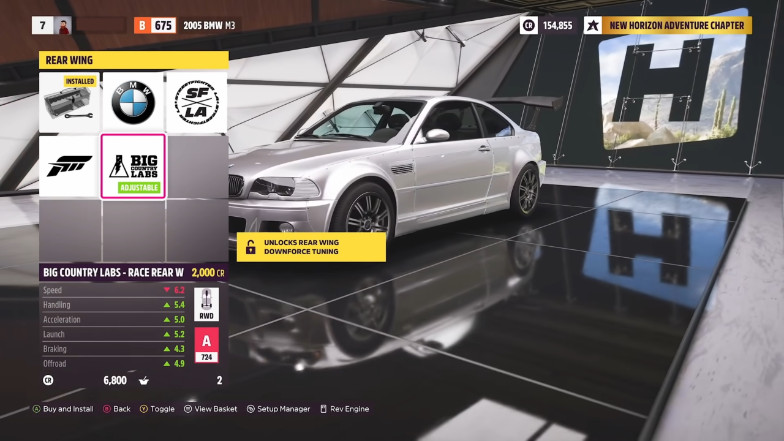
Adjusting your aero basically has you deciding whether you want your car to be quicker in corners or if you want to get faster in a straight line.
Front Aero
The forepart aero is responsible for keeping your forepart tires glued to the basis so it is ever best to max this out in order for grip and turning to be at its best.
Rear Aero
Rear aero on the other hand has a bit more liberty to it. Yous can opt to maximize this setting to go along your rear in check (and thus accept more than rear grip during corners) or set this to its lowest setting for better pinnacle speed.
Brake
The brake category is pretty cocky-explanatory. It gives you both brake balance and restriction pressure.
Brake Residuum
Having more front brake bias will have y'all stopping better but it will upshot in an increased adventure of locking your brakes which volition have your automobile going direct past a corner.
With this in mind, we will always go with more rear restriction bias as though it decreases stability during braking, information technology allows for smoother braking. That and oversteer is improve than understeer. This is specially truthful for drift and offroad builds as we would want our car sliding through corners.
Brake Force per unit area
Brake pressure is simply to be put at its maximum, especially if you have ABS on as i of your assists. This is to increase your braking power and in plough accept you slow down quicker and sooner.
Differential
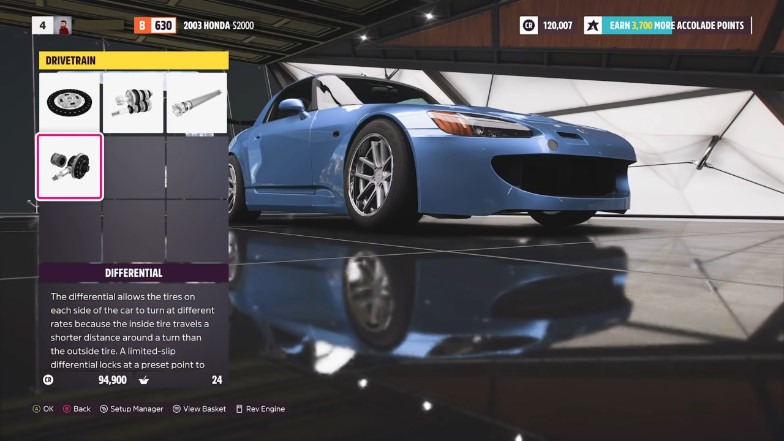
Differential tuning is the last category available. Differentials help with handling and ability response by giving more torque to the tire with more than grip. It tin also let the wheels spin at independent speeds to keep stability under dispatch or deceleration at the cost of outright speed.
It is good to note that for FWD cars, you can just tune your Front Differential, for RWD cars, your Rear Diffs but and for AWD cars, both front end and rear diffs plus a center differential.
For single-drive layouts, increasing your acceleration slider on the differential will assist you in distributing power evenly on both wheels. The problem is that too much dispatch will result in less stability when putting down the power.
For deceleration, it is better to go all-out independent so that braking is much smoother with trivial-to-no chance of locking up.
For AWD cars, you lot will also have an choice to tune a Centre diff. This affects how much ability is being sent to either your front wheels or your rear wheels.
You would want to ever brand this biased towards the rear in gild to counteract the understeering nature of AWD cars but not too much that you end up with an RWD car with added on weight.
Tunes by Racing Discipline
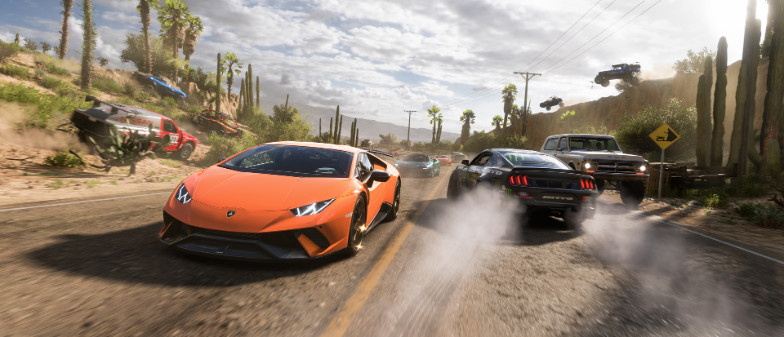
Now that we know what each tuning category and tuning pick does, we can at present apply this cognition to our cars. But of course, it does not end there equally we demand to decide what our motorcar volition specialize in, whether information technology be a drag strip demon or an offroad monster.
Below will be a list of the dissimilar racing disciplines bachelor in the game and how you lot should melody your auto appropriately.
Something good to note is that each auto will be different from ane another, and then take this guide every bit something to get-go with rather than it being a template. The fine-tuning will be the i to yous apart from the residue.
Road Racing Tunes

Forza Horizon 5 is comprised of a lot of road racing tracks so learning to melody here is pretty much the gateway to a lot of your tuning prowess.
What we by and large desire from road racing tunes is a stiff intermission setup (shut to half or halfway in the tuning bars) for stability and cornering aero turned to the max for faster cornering speeds. We besides want to be at our everyman when it comes to ride elevation in order to make the about use out of our aerodynamics.
Tires should also lean towards the softer side of things (20-25 PSI) every bit we want more grip when it comes to road racing.
Gearing volition depend on your preference, but it is always a good idea to brand your terminal bulldoze tuned for top speed to take reward of the long straights strewn across Forza Horizon 5's map.
All-Cycle Drive (AWD) Melody
When information technology comes to the Forza Horizon physics arrangement, AWD tunes are usually the best in competitive races since it gives you the nigh grip off the line, making for better dispatch, and an easier fourth dimension controlling a car in the go out of corners since power is evenly distributed out to all wheels.
The downside of this blazon of drivetrain is that it is more prone to understeering and an AWD swap or AWD machine in general ordinarily weighs a lot more than either FWD or RWD cars.
To counteract this, make sure that your pause and antiroll bars are stiffer in the rear in order for your AWD car to slide a flake more. Heart differential as well plays a huge office here equally you can set your AWD system to be a bit more rear-biased (around 70-75%) for an easier time.
Caster should also be gear up a bit lower than usual (values of around five.0-6.0 degrees) so that nosotros are given more turn-in.
Lastly, we can besides brand our tire pressures mimic our break settings to further assist our AWD motorcar be a bit more forgiving in the corners.
Rear-Cycle Drive (RWD) Tune
Although dull off the line, RWD Forza Horizon 5 tunes come alive after the beginning of the race where their reduced weight and nimbleness shine better than AWD cars. They besides assail corners much better since they have more control of their front tires.
The trouble they impose is their love of powersliding too equally a tendency to wheelspin in corner exits leading to spins.
To counteract this, we make the forepart break and antiroll bars of our car stiffer than the rears. Since our differential only affects two wheels, we set it to be at around lx for acceleration and 0-20 for deceleration. This makes our RWD cars a lot more stable when coming out of slower corners.
We can also counter this abundance of ability by tuning the gearing to accept a longer ratio in order for power to come in at lower revs in order for the tires to catch grip first before going loose.
Forepart-Wheel Drive (FWD) Tune
Just like AWD cars, FWD cars are more than understeer-heavy, but unlike AWD cars, they are manner more than nimble due to their unparalleled lightweight merely like RWD cars.
Equally such, tuning for FWD cars should pretty much be a combination of both AWD and RWD cars in that we tune to reduce understeer while also keeping in listen that power only goes into ii wheels.
Stiffer rear suspension and antiroll bars will do us really good while a longer gear ratio tin also exist justified to control the power output to the front wheels.
Something a lot more important than the other drivetrains to consider here is the tuning of the brakes. Since the front tires will be doing nigh of the piece of work, it would be a great idea to take a rear-biased braking setup to have the front tires be a little libation to perform better.
Clay / Rally Tune
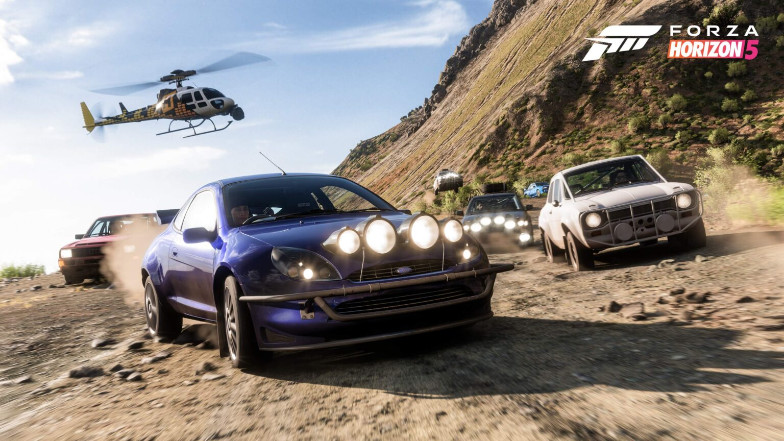
There really is simply one drivetrain that dominates rally racing and that is AWD, so this department will only discuss an AWD tune.
When it comes to rally racing, nosotros want our car to be as quick and nimble as possible but also tough enough to handle the uneven surfaces of dirt and gravel.
One thing to note is that not all rally races will take part wholly offroad, at that place will exist races that combine both dirt as well every bit tarmac. With that, we should account for both disciplines.
Every bit such, the nearly of import setting to tune hither is the pause. When it comes to rally, we would want a much softer setting than in road racing, but also non as well soft that it makes us unprepared for tarmac sections of a track.
Antiroll bars should also exist on the softer side so as to not upset the car when going through uneven terrain.
But like the AWD tune for road racing, we prepare our break and antiroll bars to exist stiffer on the rears than the front end to help the states slide in the offroad sections.
Ride height should as well be a flake higher, around an inch or 2 more than our road-racing counterpart just to be safe from bottoming out when going over moderate jumps and clearing some puddles.
Tires should be softer as well (10-15 PSI) to account for the crude terrain. For gearing, nosotros get for a shorter gear ratio every bit when it comes to rally, acceleration is male monarch rather than top speed. The faster we go through gears, the better as it also helps u.s. keep traction on offroad sections.
Finally for our differential, it is up to you whether you want to take a truly 50-fifty AWD automobile to account for the low-grip sections, or something like 65-lxx biased to the rear in club to brand the car livelier on the corners.
Cross Country Tune
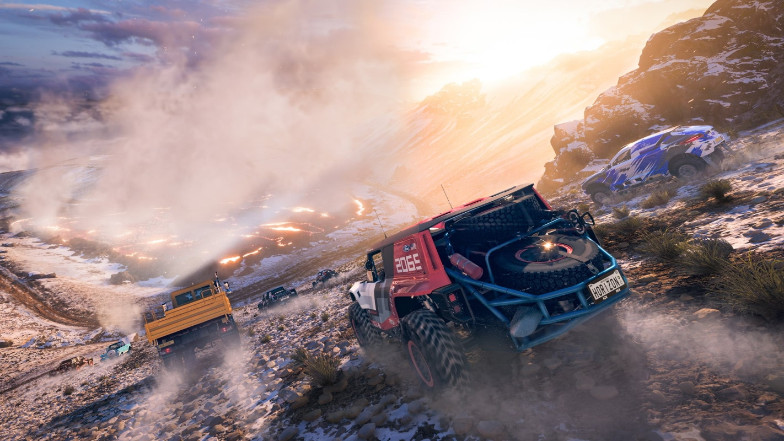
But like our rally racing FH5 tunes, cross country is completely dominated by the AWD drivetrain so nosotros will focus on that drivetrain when tuning your car.
Although largely like to how we tune our rally racing car, cantankerous country racing involves a lot more jumps, a lot more obstacles, and takes place almost entirely offroad.
With that in mind, we will want to have suspension and antiroll confined softer or on-par with our rally build but ride height to exist comparatively higher to account for the bumps and jumps that will be littered throughout the cross land tracks.
Tires should also exist a lot softer (less than 10 PSI) to account for the corporeality of terrain you will be racing on, as cross country racing unremarkably involves all types of terrain from dirt, to sand, to grass, to gravel.
Pulley should also be reduced (around five.0 degrees) as nigh of the cars used in this blazon of racing volition be sluggish when it comes to steering, so a little more steering angle will help in the long run.
Gearing should also exist a little bit longer than rally races since cross country racing tends to lean towards faster, straighter tracks with long corners instead of the complexity of rally tracks.
Finally, when it comes to the differential, similar rally racing, information technology is up to you how much you would want your car to slide, then tune accordingly.
Drag Tunes
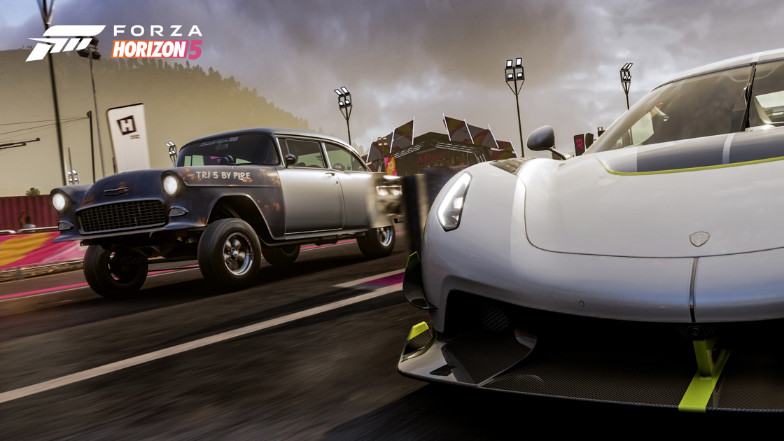
When it comes to drag racing, tuning cognition from the other types of racing disciplines is pretty much thrown out the window equally drag racing has its own priorities and deals with the extremes instead of the fine-tuning required in other racing disciplines.
Getting your gearing right is the most important FH5 drag tune when information technology comes to drag racing. We would desire to go far then that our gear ratios e'er striking the acme of our ability ring (this can exist seen in the upgrades section) so that ability is always being used to its fullest.
We would also want to make information technology so that our showtime gear reduces the amount of wheelspin we produce equally wheelspins in elevate races are a waste of speed. Make information technology so that before fifty-fifty reaching the rev limit of your first gear, your tires accept already institute grip.
Do non make the gears also long though as as well much grip will result in a very sluggish and anticlimactic launch with your car's power non beingness plenty to propel the car forward.
Slant and toe tin be kept at 0 degrees (or expressionless straight) as at that place are no corners to be taken in a drag strip, but the caster should be fix at its maximum and then that stability in speed is likewise increased.
Brake tuning tin can pretty much be ignored because if yous are braking in drag racing, you are doing it wrong.
For our differential settings, we put all dispatch options to the maximum to have the absolute best launch and have our tires exist working optimally at all times and deceleration options to the minimum as over again, we are non going to slow downwardly in a drag race.
Lastly for aero, we should have any aero part unequipped to increase our speed, only if a motorcar has its aero tuning options unlocked, just put it at the lowest to increase height speed.
All-Wheel Drive (AWD) Tune
With superior launching capabilities compared to your two-cycle drive counterparts, you will exist certain to leave RWD and FWD tunes in the dust at the start, but your weight might merely bring you downwards.
Drag racing in an AWD motorcar is all most balance every bit we would want all our tires to have the optimum grip for us to launch very quickly.
With this in mind, nosotros tune our suspension to be incredibly soft all around except for our crash-land stiffness and front end rebound, which nosotros should set to the maximum stiffness. This is to ensure that all our tires accept the biggest contact patch on the route at all times.
For ride height, we ordinarily put the rears to exist higher than the fronts as nearly of the weight shifts to the rear when launching. This puts more grip on the rear tires and does not overload the fronts.
Finally for our differential settings, since nearly of the weight will be traveling to the rear at launch, we put more emphasis to power on the rear (around seventy-fourscore%) in order for our rear tires to deliver most of the power to the road.
Rear-Wheel Drive (RWD) Tune
Although its launch will non be as good as an AWD tune, its weight might simply edge out an AWD tune when information technology comes to top speed runs.
When drag racing an RWD car, you lot want to take the weight and power of the engine and have it shift from the forepart to the back and the front once again. If not enough power is pushed towards the back, this will issue in wheelspin. If too much weight is forced to the dorsum, the car will wheelie or lose ability.
With this in heed, for damping, we would desire our front rebounds to be soft to elevator the front tires a bit and rear rebounds to be in the middle so that when coming from a launch, it lands smoothly.
The rear rebound should be stiff while the rear bump should be soft to assistance put the ability down onto the tires even more.
Rear antiroll bars should exist prepare to the stiffest so that power and weight are kept evenly throughout the rear tires while the front antiroll bars set to the softest to allow for better grip by the front tires.
Tires should exist tuned with the rears being the softest while the fronts being the hardest. This ensures that the tires that power goes into have the best possible grip available at whatever given moment.
Front-Wheel Drive (FWD) Melody
Although non as common every bit the other 2 drivetrains, FWD cars are still enough viable in the elevate racing community.
Since power is being delivered to the front wheels, we will need to brand certain that the weight stays in the front in society for the front tires to grip.
Tire pressure level for both the front and rear tires should be the softest as we desire both front and rear tires to be gripping the road every bit much as possible.
For our pause setup, we can go for a potent setup with the springs beingness a bit stiffer in the front than the rear. Antiroll confined should be ready to be the stiffest too as this will help in redistributing the weight to the front tires rapidly when launching.
For damping, we go for soft front rebound stiffness and stiff front bump stiffness and the contrary for the rear rebound and crash-land stiffnesses. This compounds the effect where weight is distributed to the front end during a launch.
Finally for our camber, nosotros put the rears in a positive camber (effectually 1.0 degrees) for it to reduce a bit of drag when information technology comes to rear wheels and assist with straightening the car our when launching.
Drift Melody
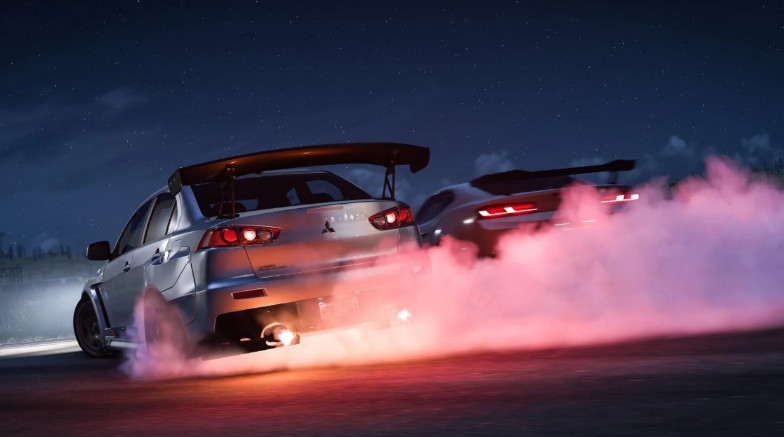
Although there are AWD cars that can drift, the most effective (and traditional) cars for drifting tunes are RWD, and then nosotros will be focusing on an RWD tune just.
Similar drag racing, the rules to tuning drift cars are significantly different from tuning a normal race car because of the nature of drifting, where style goes beyond speed.
Let us first off with tires. The front tire pressures should be prepare moderately soft (effectually 25-30 PSI) while the rears are left to be at their softest. This allows for great amounts of grip in the rear while assuasive for swell transitions between grip and loss of grip which is pretty much how globe-trotting is (a controlled powerslide).
For gearing, shorter gear ratios are preferred to get your car to be shut to total rev all the fourth dimension (which leads to wheelspin) while allowing yous to accelerate fast and proceed the wheels turning during a migrate.
For alignment, e'er get for fully-negative slant for the forepart wheels while going slightly-negative camber (0-one.0 degrees towards negative) for the rear wheels.
Front toe should be gear up to total toe-in while the rear toe setting depends on the drifts that y'all are trying to pull. If y'all want more than controlled and longer drifts, become for toe-out. If you want sharper and more angled drifts, go for toe-in.
Caster should exist set to the maximum as it allows for meliorate slant and the steering angle brought by the drift suspension makes certain you tin plow on a dime despite this high caster setting.
For antiroll confined, set up the fronts to be slightly towards soft while the rears to be at their softest settings. This allows for maximum grip while drifting. If you lot are experiencing as well much grip, stiffen the rear anti rollbars past a petty.
For springs, they follow the aforementioned logic as antiroll confined, but that your rear springs just be a tad scrap softer than the front end springs instead of them being fully soft. For ride tiptop, you should always get as low as you can become.
For damping, drift setups will adopt a stiffer rebound setting (around half to 3/4 of the bar) and a softer bump setting (effectually 1/4 of the bar). This means that the cars will get to lean a lot due to the soft bump settings merely immediately straighten out due to the strong rebound settings.
For aero, simply set to their lowest setting as we do not actually need them due to aero being largely ineffective when traveling sideways.
Brakes should be prepare to a completely front-biased setting in order to take more than control mid-drift and brake pressure to exist set to its maximum besides for more than ambitious transitions.
Lastly for our differential settings, we will put both acceleration and deceleration to the maximum as we want our wheels to lock up easily and consistently.
Which Upgrades Should I Prioritize?
NOTE: This section tin be ignored if you lot are edifice a drift or drag machine equally the rules on tuning for those types of cars differ very much from normal racing. That and form does not really thing with those types of cars.
Earlier nosotros touch on tuning, nosotros will beginning take a detour into which operation upgrades nosotros should prioritize every bit these go hand in hand with tuning.
Deciding which upgrades to install into your car will too depend on the class yous are trying to get your motorcar to fit into due to how much Performance Index (or PI) points they add to the car.
We volition likewise be looking at how effective these upgrades are to a class. You could have the best tires, but if yous are only running a D-grade car, those PI points would be better spent on another component like boosted power.
Below, you will find the automobile classes in the game and the performance upgrades you should prioritize (and avoid), also as explanations every bit to why this is the case.
Upgrades that you should always install
1. Platform and Handling
- Race / Rally Bound and Dampers
- Race Front Antiroll Bar
- Race Rear Antiroll Bar
two. Drivetrain
- Race / Rally / Offroad Differentials
iii. Tires and Rims
- Front Tire Width (for FWD cars only)
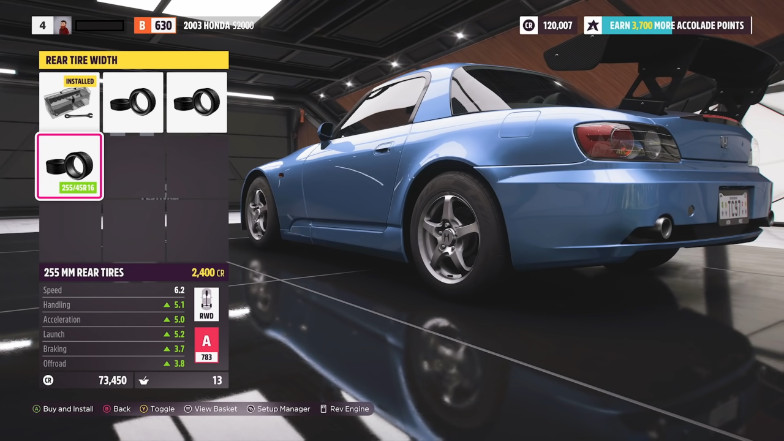
- Rear Tire Width (for AWD and RWD cars merely)
- Rim Style
- Front Rim Size
- Rear Rim Size
- Front Runway Width
- Rear Track Width
4. Aero and Apperance
- Adjustable Rear Fly (for AWD cars merely)
The Platform and Treatment and Drivetrain upgrades are pretty much a must because they unlock a chunk of the tuning options bachelor to the car while adding negligible amounts of PI points (normally they volition only add 1-5 PI combined) to a machine.
For the Tires and Rims upgrades, these also add very little PI points to your builds while increasing the drivability of your cars. In the case of the Rim Style upgrade, bated from being a stylistic choice, y'all can choose to equip the heaviest wheels in club to lose PI to spend on other upgrades.
Lastly, I put the adaptable rear wing as a necessary upgrade for AWD cars only considering rear wings on AWD cars decrease the PI of the motorcar even though it benefits its drivability.
Try to make it a habit to upgrade these parts no thing what automobile or course you lot are building.
Upgrades that you should avoid at all costs
1. Engine
- Intercooler
- Oil / Cooling
2. Platform and Handling
- Chassis Reinforcement / Roll Cage
3. Tires and Rims
- Front Tire Width (for RWD and AWD cars simply)
These upgrades are to be avoided at all costs as they provide PI simply in plough, virtually ever brand your car worse. In the case of the Engine and Platform and Treatment upgrades, they add a lot of weight but return very footling gain in either power or stability. Y'all are better off building your automobile without these upgrades.
Front tire width is a special case for RWD and AWD builds. We will want to avoid this upgrade every bit they add together a meaning amount of PI for niggling to no benefit. However, y'all can upgrade this if and only if your stock tires are besides skinny.
Skinny tires lead to an abundance of oversteer and to counter information technology, yous can increase the front tire width of a car. In general though, it is all-time to go along it stock.
D-Class (500 PI)

D-class is the lowest available class of cars in Forza Horizon five, it is also i of the nearly restrictive classes in the game because of how many of the upgrades yous are restricted to because of the immense PI gains you become from them.
Cars in this form usually top out at effectually 115-125MPH but their agility and predictability more than make up for their lack of power.
Engine
When it comes to upgrading your D-class cars, power is more probable the number one priority as they commonly lack power just are lightweight enough to compensate for it.
Their engines are besides by and large naturally aspirated (or NA), pregnant air intake is natural and there is no forced induction (something a turbo or a supercharger does).
Therefore, if you desire a substantial ability boost, you lot may install a turbo or a supercharger if your PI allows. In the rare instance your D-form car has a turbo or supercharger, focus on upgrading that element in the Engine carte.
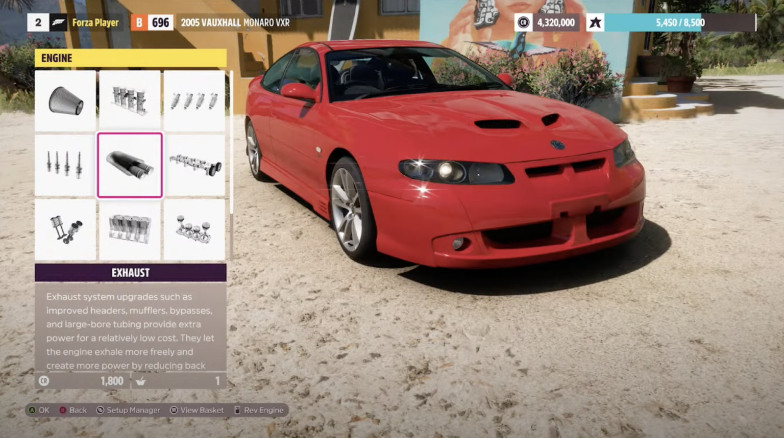
Otherwise, if yous are strapped for PI, always focus on upgrading your frazzle and camshaft. Upgrading your exhaust provides quite a bit of ability just it also reduces your weight by quite a lot making it a very cost-constructive power and weight upgrade.
Upgrading the camshaft, on the other hand, increases your redline, making your engine stay in its superlative ability longer before shifting to a college gear allowing for better power. It also increases your engine's power by quite a lot.
As for the other parts in the engine, use them to maximize the amount of ability you can get while keeping an eye on your PI. Yous can generally ignore the flywheel on D-class cars as the weight y'all reduce from it does non upset the PI you gain.
Platform and Handling
With bound and dampers and both antiroll confined existence essential upgrades and chassis reinforcement/roll cages existence ones to avoid, we are left with brakes and weight reduction.
For brakes, street brakes are more than plenty for D-class as the speeds you volition be stopping from are not high enough for sport and race brakes. It too saves united states quite a lot of PI points to use in more important upgrades.
As for weight reduction, this depends entirely on you whether yous will desire more power or a machine that is a bit more nimble. With heavier cars like the Hummer H1 and Unimog, yous will desire to upgrade this, but for lighter cars, yous will want to look at engine upgrades instead.
Drivetrain
The upgrades establish in the drivetrain bill of fare are virtually e'er worth information technology specially for classic and retro cars considering of their slower clutches
Upgrading your clutch volition lead to ameliorate shift times, therefore faster acceleration. I would probably always recommend the race clutch to get the all-time benefit for very little PI boost.
For transmission, you can choose to either go for sport transmission or race transmission. Sport manual volition permit you melody only the final drive but price less PI than race transmissions which permit y'all fully melody your gear ratios.
Race transmissions besides get heavier the more gears yous determine to add. Since we are in D-course, the 6-speed race manual is plenty.
Lastly, y'all can use the driveline upgrade to put a bit more than PI to maximize your build. Information technology is not a necessary upgrade, only if you are looking to clasp just a bit more PI to reduce your weight, and then get for information technology.
Tires and Rims
Because of the PI added by any tire chemical compound, we are forced to keep information technology stock. You can possibly opt for street tires if you want, merely ability will e'er be more than important in races.
This also applies to rally and cross land builds. Rally and offroad tires price besides much PI for a machine to stay in D-class when equipped.
Aero and Appearance
The effect of aero on a D-form car is very negligible so it is best to ignore these upgrades if y'all are looking for operation gains.
Conversion
Engine swaps are sadly out of the pic as they only add together too much PI to go on your machine in D-class. Drivetrain swaps are also a bit useless in D-class as they add together too much PI versus your stock drivetrain.
This leaves the states with the aspiration upgrades which are highly recommended. If your PI allows, equipping a turbo or a supercharger will assist a lot with the ability woes.
Equipping an aspiration upgrade also opens up the appropriate upgrade pick in the engine menu for you to further increase your ability.
C-Class (600 PI)
C-class cars are a scrap quicker than D-grade cars. Most of the cars found here are classic muscle cars and classic sports cars capable of reaching speeds of upwardly to 130-145MPH.
Just similar D-class, you would desire to focus on ability except for this time, you volition accept a lot more room to upgrade due to the boosted PI.
Engine
Similar to D-class builds, y'all would want to focus on your engine upgrades. Due to the additional PI you are allocated though, yous accept more liberty in choosing your upgrades subsequently your exhaust, camshaft, and forced induction upgrades.
Adjacent in line for engine upgrades to look at are your intake, pistons/compression, and intake manifold/throttle body upgrades. These upgrades offer a bit of power as well as a flake of weight reduction every bit well making them great secondary options.
Platform and Handling
With the increase in PI resource allotment, we can now look more than into the weight reduction upgrades. If you feel like your car feels a bit sluggish in corners and in its acceleration, go for weight reduction.
For brakes, we would all the same be going with street brakes as they are however a massive comeback from the stock brakes for the PI information technology gives out.
Drivetrain
Since C-class still deals with cars that are considered retro and classic, the clutch upgrade is all the same very much of import because of its event on decreasing the shift time of your car.
Transmission is notwithstanding a thing of choosing between Sport and Race (six-speed only) since nosotros are still dealing with relatively depression-speed racing. Use the driveline upgrade to discover that 1 or two PI that yous need to push your C-form car to the limit.
Tires and Rims
As with D-class cars, C-class cars can still role fairly well with stock tires, however, if you lot are building a car with a higher top speed, you lot might desire to invest in street tires to offset the ability.
Aero and Appearance
The effect of aero on C-form cars is all the same quite negligible and so treat it every bit an aesthetic choice rather than a operation upgrade still.
Conversion
With a bit more PI points at your disposal, engine swaps are a bit more than viable now. In that location are some engines that volition upgrade D-class cars to C-form and most of the time these bring bigger gains than upgrading the stock engine, so always endeavour to see if you can engine swap.
Drivetrain swap is even so a personal pick. All drivetrains on this class are yet very much viable. Finally, with the additional PI points, you should ever be on the picket if you tin equip an aspiration upgrade as they bring the biggest power gains.
B-Class (700 PI)
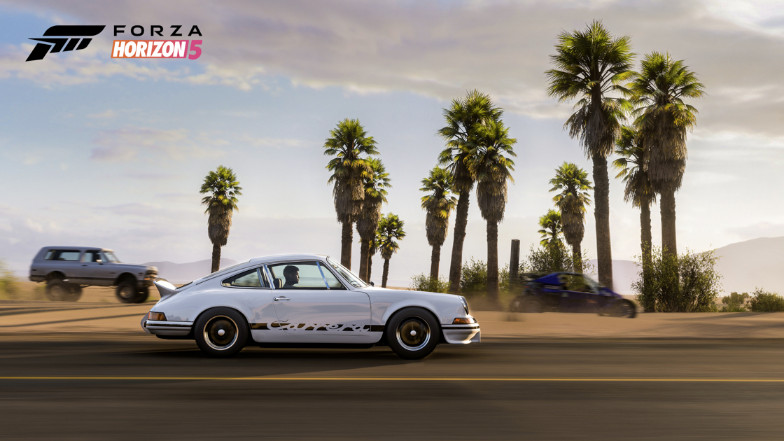
B-class sees even more choices to choose from with modern hot hatches and modern sports cars entering the mix. Cars tuned to this class can hands attain a tiptop speed of 145-165MPH.
Power still plays quite a big role in this class, simply the higher PI gives you more options if you want to branch out into a more nimble automobile with treatment upgrades.
Engine
The upgrade path in this class is very similar to C-class, just that in this case yous put higher stage upgrades to the main engine upgrades (camshaft, exhaust, and forced consecration) and pair it with lower stage upgrades of the other options.
Platform and Handling
Sport brakes can at present be an choice hither as we are dealing with a lot more ability than the previous classes. It also reduces weight which is always a great thing although street brakes can even so exist an option if PI is an issue.
Weight reduction should also be looked at but not prioritized. Phase 1 or ii is enough for cars in this class.
Drivetrain
Clutch upgrades start to get a bit less important in this grade considering of how modern cars do non actually have much to gain from them. Only upgrade information technology if it still shows a reduction in shift time.
The choice of manual is notwithstanding between sport or race (6-speed only) transmissions. Driveline upgrades are still to be used as a small PI gain upgrade In this instance, it is to be prioritized over clutch if clutch upgrades practice not provide a reduction in clutch times since it reduces more weight.
Tires and Rims
Any tire chemical compound below street should non exist an selection in this class anymore as the speeds are much higher and you will be needing the grip not just for cornering simply for braking as well.
The aforementioned goes for offroad or rally builds, unless it is a pick-upwards or SUVs every bit they usually accept decent stock tires that count as offroad tires.
Aero and Advent
Aero effects on B-class cars are still non big plenty to warrant equipping them and then it is still best to ignore them for functioning gains.
Conversion
Engine swaps in B-class open a bit more than customizability and options for yous as there are a lot of engines that put your right in B-class. Consider doing these every bit they are a scrap more cost-effective than upgrading your stock engine.
Drivetrain swaps are withal a bit of a waste in PI as all drivetrains in this form are still viable.
As for forced consecration, information technology is e'er a good add-on to the machine in this class, then long as your PI allows it. Merely it is always a practiced thing to prioritize it in this course.
A-Class (800 PI)
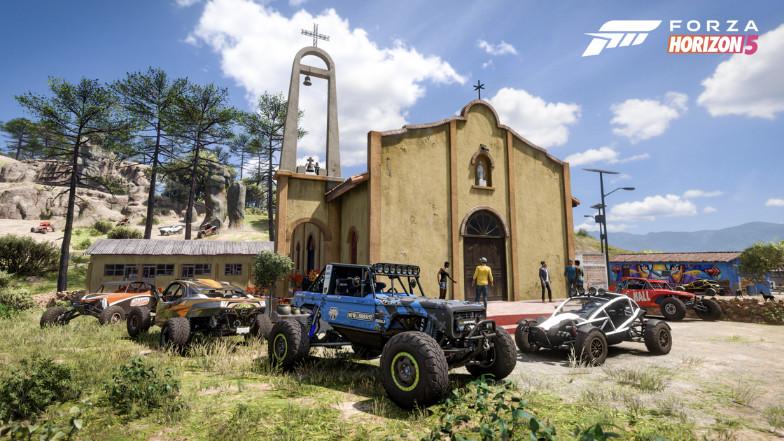
Moving on up to A-class which is considered to exist the mid-range form. Some supercars brand their way in this class, but you will most likely be seeing tuned-upward retro and classic cars here equally their starting PI lead to some crazy builds.
Cars in this class reach anywhere from 160-180MPH tops.
Engine
The increased PI definitely opens up a lot more than options when it comes to engines. Just go on getting the higher stages of the main engine upgrades, and if they are maxed, max out the others as well. Power plays a huge role in A-class and then try and prioritize this as much as possible.
Platform and Treatment
Sport brakes are pretty much a requirement at this course as the speeds are a lot faster now and you will be needing that actress stopping power.
Higher stage weight reduction should as well exist prioritized now as there are a lot more power upgrades you lot can get, and reducing weight only compounds those upgrades really well.
Drivetrain
As with the previous course, clutch upgrades run into a reduction in priority because of the nature of the cars in this class. Start treating these upgrades similar the driveline upgrades: something to gain a bit of PI by reducing a flake of weight.
Race transmission (six-speed) is a must in this class every bit it helps to tune all gear ratios now for amend acceleration.
Tires and Rims
Tire compound pick in this class is a chip more than complex than in the previous classes. What I personally do is equip sports tires for FWD or RWD cars since they need boosted grip while only equipping street tires for AWD cars since they are a lot grippier in nature and do non demand the boosted grip from sport tires.
For offroad and rally builds, it is an option to look at the rally and offroad tires this time as cars in this class are a lot faster and you lot will need a lot more grip to deal with the power.
Aero and Appearance
Aero effects are still a fleck minimal in this class, front bumpers especially. Rear wings, yet, could be seen as an pick at present to provide a bit more than mid-corner grip at the price of a fleck of directly-line speed.
Conversion
Engine swaps are practically a must in this class now due to the corporeality that is offered and their cost-effectivity.
Drivetrain swaps, I would argue are still not needed, only if you lot are feeling a bit uncomfortable with either FWD or RWD at these speeds, then bandy away to AWD.
If the engine swap you picked out is an NA engine, always selection out a turbo or supercharger to pair it with to give your car even more ability for quite the moderate corporeality of PI.
S1-Course (900 PI)
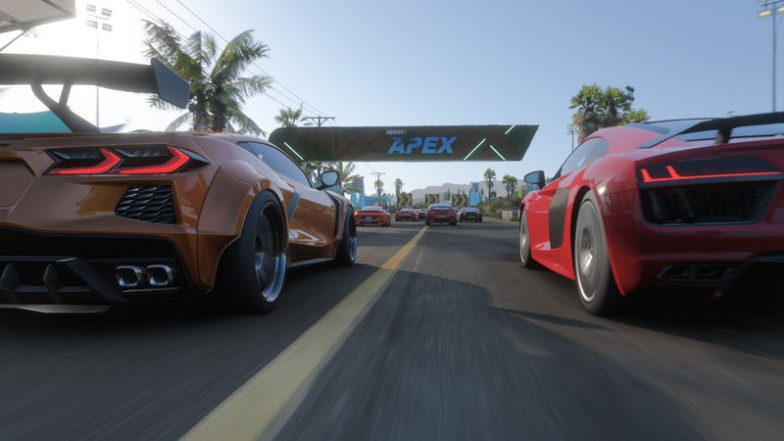
S1-class is the form where you will see the most variety in car types as almost any auto type tin can be tuned up to here, disallowment the absolutely mental hypercars and runway cars that already accept a PI by 900. Cars in this course tin reach speeds of up to 190-220MPH.
Engine
Past this course, yous will nigh likely be able to upgrade everything except maybe some select engine swaps that will shoot your car up immediately to S2-class. Power is still very much of import, just practice not overdo it.
Simply remember to prioritize your camshaft, frazzle, and forced induction upgrades when it comes to power. Then fill your PI allocation with the other upgrades appropriately.
Platform and Treatment
Race brakes can at present be looked at as an selection in this grade simply if PI is still tight, sports brakes are very much still relevant in this course.
Weight reduction also plays a key role in this course. Brand certain to always get the highest weight reduction you can get available. The only exception would be if your weight is already very low and you need more ability, then compromise.
Drivetrain
By this class, nosotros will about always be doing an engine swap so clutch upgrades should act similar the driveline upgrades where they are used to eke out just that fleck more PI to maximize a build.
Equally for the transmission, race transmissions are pretty much a must in this grade, it is simply a matter of choice on how many gears you lot volition desire, although I do recommend just sticking with half dozen or 7 gears.
Tires and Rims
The choice of tire compound in this grade will pretty much always be the semi-slick race tires (if road racing) as they offer good enough traction for less PI cost. They also exercise not endure likewise much traction loss when going offroad for a bit unlike the slick racing tires.
For rally and cross-country builds, always choose the rally or offroad tires.
Aero and Appearance
Aero in this grade is pretty much a requirement so equip any adjustable rear wing and forepart bumper so that you tin can unlock the aero downforce tuning options.
Conversion
Engine swaps are very much a must in this class. Always take note of the power information technology gives out as well every bit the weight it reduces/adds to the car so pick wisely.
If you are good plenty with throttle control, you tin leave your drivetrain as RWD, but in general, you will desire to swap to AWD equally they offer better acceleration which is very important at the start of races.
Every bit with the previous class, if the engine swap you picked is an NA engine or has a weaker forced induction office (single turbo versus twin turbo), swap it out for something a lot more than powerful.
S2-Course (998 PI)
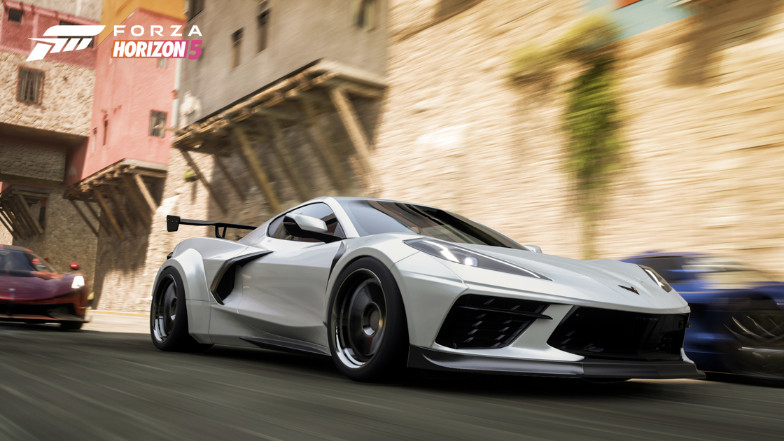
The class that any type of machine tin have function in. From your classic musculus cars to your hypercars, this is where they converge. Cars in S2-class can top out at 235+ MPH and beyond.
At this indicate, you lot tin almost ever equip every upgrade to a car and information technology will be nether or just hit 998 PI, the only exceptions are cars that already take close to 998 PI like the Koenigsegg Jesko and the Ultima Evolution Coupe 1020.
Therefore, upgrades in this class matter a lot less than in previous classes and it will mostly come down to the driver'due south skill and their tuning.
You can also commencement experimenting with the college-numbered transmissions as the power from these cars certainly mates well with more gears to churn through.
If you are striking X-class with your upgrades, just cull whether you volition desire more power or a amend treatment machine and focus on those specific upgrades.
Just make sure to e'er equip the appropriate tires to your racing subject field, all adaptable aero available, as well as conversion swap to AWD if your car is not AWD and you lot will do fine in this class in terms of upgrades.
X-Class (999+ PI)
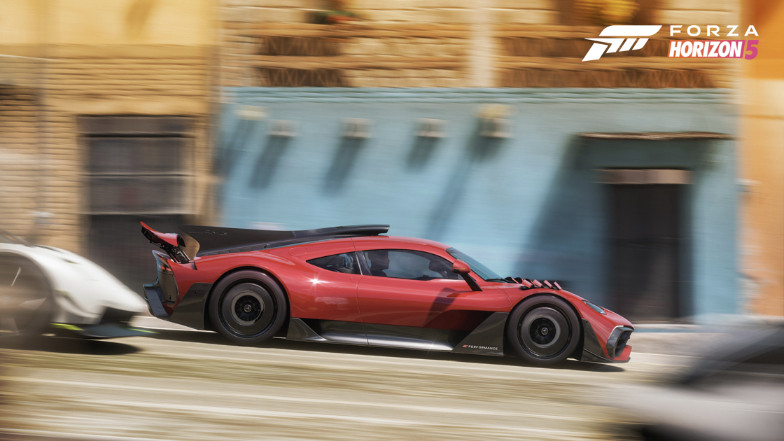
X-course is pretty much unrestricted racing, then go wild with your upgrades! Get the lightest wheels, bandy in the most powerful engine, put on the stickiest tires, basically max everything to get the edge over your opponents!
I would recommend swapping to AWD though equally cars in this class have incredible amounts of horsepower making whatsoever other drivetrain virtually-impossible to drive with.
Final Thoughts
This brings our Forza 5 tuning guide to an stop. Tuning is a process. In one case you lot have ready a base melody, you must drive your automobile for a bit and run across what other things tin can be improved upon. From there, you can fine-melody your settings to truly perfect your auto's performance on the runway.
With the being said, tuning also makes our cars distinctively ours every bit not everyone will have the same preferences when information technology comes to your Forza Horizon five setups. Information technology gives them a distinct personality. So accept fun tuning and make your cars your ain.
hatfielditell1953.blogspot.com
Source: https://diamondlobby.com/forza-horizon-5/best-tuning-setups-for-forza-horizon-5/

Post a Comment for "How to Upload Tunes From Older Version Forza"